Thursday, July 14, 2011

Garrett Infinium 3x7 DD Double D Pulse Induction Coil (draft)


This is the 3x7 in. Double D coil for the Garrett Infinium Advanced Pulse Induction metal detector. Some will tell you this is good for river bed crevasses while prospecting and in trashy areas.

 
Limited depth is this coil's weakness, but it will still go 6 or more inches on a gold ring depending on it's size. The big gain here is that this coil will let you hunt where there is too much electrical or radio frequency interference for the other infinium coils to work right at all. So it's sometimes like my "secret weapon" that I only use rarely. And when the false signals from wave swells in the salt water make you turn up the discrimination (also tuning out small 1/2 gram and up gold and diamond earrings), This coil will NOT give those false signals so you can turn discrimination all the way down (off)!


Very small gold from salt water is a tall order that this coil can deliver.

 
Getting back to the Volleyball courts, I could have just picked these things up with my AT Pro because it is a high frequency machine (15Khz).

Metal detectors with a lower frequency would have probably ignored these items because of their small sizes. My 7.5 Khz GTA350 can bareley see any of them at 1 inch, my Fisher 1280-x 3.5 Khz ignores them almost entirely.

The coil is not for scuba but has worked just fine in less than 10 foot of water, and so far hasn't leaked. Even though it is a tiny coil, because of the "Blade" type of foot print it makes when "seeing" through ground it is not much different for ground coverage than the 8 inch mono coil that has a "Cone" shaped footprint.


The dry sand part of the beach is not flat so the little coil hugs the ground well in footprints and can be pushed into the sand somewhat easily. I did find all these things with it on 2 different occasions within 1 hour in dry and wet sand, all were found in and around Volleyball courts except the large square earring next to the gold tooth which was found in the surf:


Pinpointing with a small coil is great but you better bring your pin-pointer for when these guys fall through your coin scoop holes over and over (it can drive ya nuts!)


I was hoping the slightly bigger 10X5 inch sized double D coil for the Infinium would have also ignored the wave swells that the 3x7 eliminated but after purchasing and trying one, I am sorry to say it did not. On top of that, I could hardly keep the coil underwater because of the air inside. It does however eliminate power interference quite well in my area.

It detects deeper than the 3x7 and pinpoints like a dream in Volleyball courts so I will now use the smaller one for wading only.

Wednesday, July 13, 2011

Agrihan Island Northern Mariana Islands

http://thelongestlistofthelongeststuffatthelongestdomainnameatlonglast.com/

http://treasurestories.com/Pacific/AgrihanIsland.htmRoberton was a mercenary and a pirate. He was a Scotsman who, in 1817, was in the employ of the Chileans fighting against the Spanish. He was of medium height, red hair and “a repugnant sight” and was known to be savage and cruel.

A couple of years later, he was involved in the attempt to capture the bandit Benavides. He captured a friend of the bandit, a man named Pacheco, in Arauco, Chile. He “extracted” information as to the whereabouts of Benavides from Pacheco. With a small army, he took Benavides by surprise and captured his men. Benavides escaped. Roberton hanged all sixty men in a clearing, but not before getting information from them. They told of booty hidden on the island of Mocha, off the coast of Chile. Roberton moved there with his brother and some others loyal to him. One day, while in a small boat on their way back from Valdivia, his brother and most of his men drowned. Roberton could not continue his existence there and left to join the Peruvian Navy. There is no further mention of the loot buried on Mocha.

While in the employ of Peru, he fought at the siege of Lima, was captured and released. He rejoined the Peruvian Navy and was living in Lima when he met Teresa Mendez.

Teresa was a 21-year-old widow of a Spanish sea captain. She was not only wealthy, but renown for her beauty. She had many suitors, but would only show interest in those of wealth and noble birth. Roberton was neither of these, but he was enamored. He pursued her to no avail. When he declared his love, she laughed at him. He persisted and she told him that if he could provide her with great wealth, she would promise herself to him. Everyone knew this would not happen.

Anchored in the harbor was the English ship Peruana. While at a meeting of naval officers, Lieutenant Vieyra joked that if Roberton could take the Peruana, he would have the money to show Teresa he was a man of means. The ship had 2 million gold piastres on board.

That night, Roberton rounded up a gang of sailors, mostly British. They attacked the poorly guarded Peruana that night and left the harbor with the ship and it’s treasure. By morning the ship, Roberton and his men were long gone.

They sailed to Tahiti. Roberton knew they had a head start on their pursuers, but he also knew they would be pursued.  He needed to convince his men to leave Tahiti and was met with some reluctance. His two most trusted men were a couple of Irishmen named George and William. Using a combination of threats and the lure of 15 Tahitian women they loaded on board, Roberton was able to get the crew to set sail again.

Roberton’s intent all along was to have this treasure for Teresa and him. Sharing it with 15 men and the Tahitian women was not part of the plan. He sailed northwest toward the Mariana Islands. At one anchorage, where he put in to load on water, he declared that 8 of his men were plotting to take over and marooned them on the deserted island.  He sailed on to the Island of Agrihan.

The first task was to slaughter the women. William was an expert marksman and started shooting the women. Some made it overboard and were swimming to the island, but William did not miss often. None of Tahitian women survived.

Next, the 7 remaining crewmembers loaded the chests containing the gold coins onto a boat and rowed to shore. They prepared a clearing at the foot of a cliff a short distance from the sea. They then buried the chests. They chopped down some trees and left some markings on the rocks to identify the area. They then set sail for Hawaii.

As they neared the Hawaiian Islands, Roberton put the next phase of his plan in place. He, George and William sealed the rest of the men in the hold of the ship. They had kept 20,000 gold pieces for their own use, climbed into a life raft and scuttled the ship. They rowed to Oahu and told of a shipwreck and how they were the only survivors.

The plan would have worked and no one would have ever found out about the marooned men, the Tahitian women, the gold being buried and the scuttling of his ship except for one thing. They did a bad job on the scuttling. The ship remained afloat. A couple of weeks after Roberton landed in Oahu, a whaling ship came across the drifting vessel. Three of the men had starved to death and one still clung to life. It took a year before the ship made it back to harbor. It landed in Oahu. Roberton and the Irishmen were already gone. The lone survivor retold his story to Gabriel Lafond de Lurcy who wrote the tale in “Voyages Autour du Monde”.


Agrihan
Agrihan
Situated 206 nautical miles north of Saipan with an
area of 11.4 square miles.  This volcano has gentle
slopes near the shore on the southeast and southwest
sides with the crater entrance on the north side.
The remaining island consists of steep slopes and deep
gorges.  The coast is rocky and steep with a landing beach
only on the southwest coast.
Highest point 3,166 ft.


The three were hunted men. They traveled to Brazil. George disappeared in Rio de Janeiro; we can only guess what happened. William and Roberton stayed together constantly, probably with a great deal of distrust between them.  They needed the treasure money so they began to make their way back to Agrihan. They arrived in Hobart, Tasmania and convinced an old sailor named Thomson to gather a small crew and take them north.

Thomson got William drunk one night and William told the whole story. William did not know the name of the island where the treasure was buried, but his description convinced Thomson that it must be Agrihan. Thomson awoke one night to the sounds of screams. William had been murdered. Thomson was now very worried about Roberton. He kept watch, but was no match for the younger stronger man. One day, Roberton just threw Thomson overboard.

But Thomson was very lucky. He managed to keep afloat for some time. A Spanish ship found him, almost dead, and he told them his story. The Spanish pursued Roberton. When Roberton reach Saipan, he jumped ship. He went into the mountains to hide, but to no avail. The Spanish captured him.

The Spanish took Roberton to Agrihan. He would tell them nothing. They forced him onto the island to show them the location, but he just stalled, looking for chances to escape. They took him back onto the ship and using the whip, convinced him to cooperate. Roberton must have known his position was hopeless. If he refused to show them the treasure location, he would be tortured. If he showed them the location, he would be killed and the Spanish would get the gold. He was not going to allow the men that captured and tortured him to profit. While the Spanish were taking him back to the island, he jumped overboard. His chains took him quickly to the bottom of the sea. He never did see Teresa after that night he decided to take the treasure.


The Spanish governor of the Marianas hired 600 natives to search for the treasure. They came up empty handed. Some believe that the inlet on the southern most west side of the island is the most likely burial site for the treasure. 

Monday, July 11, 2011

Gold Ring from wet salty sand at Sand Key Beach Florida with Garrett Infinium + 14 inch mono coil (draft)


View Larger Map


I almost left empty handed (I hate doing that) but I lucked out at the end of 4 hours off and on in and around the water. I found this 14K gold, 3.0 gram ring with the Infinium using the 14 inch mono coil in wet sand less than 6 inches down.

Tuesday, July 5, 2011

Sunset Beach Treasure Island 4th July 2011


GodlikeDude was using the old Garrett GTA350 but just found a few coins as well. He usually notches out trash, iron and coins to look for just rings. (he's too lazy to dig:P)

Not much for 1 hour with the Infinium. I guess people are too damn stupid to throw bottle caps in the garbage. Luckily, salt water eats them up after a few months.

Friday, July 1, 2011

Garrett Infinium Double D (10x5 DD) Coil Schematic + info + disection

L=0.56uH for brown coil.an L=249.4uH for the black coil with
No resistor in circuit.
The Brown coil is 26 Turns light duty tin plated multi-strand hook up style wire PVC coated
The resistance of this coil 0.9ohms
The black coil is 42 Turns light single strand Kynar wire.
The resistance of this coil is 7.4 ohms (with no resistor across)
Internally across this black coil wired in parallel is a 1/4w resistor 680
color code,blue,gray,brown,gold.

From front face of plug which is stepped in shape.
Top left exposed pin is Green
Top right exposed pin is red
Lower left pin socket is Black,with screen an Foil wrap to this.
Lower right pin socket is White.
The 5 core coil cable is foil wrapped in the sheath, cable has poly-core twine reinforcing for added strength an stretch resistance.
The Metal of the plug housing an knurled ring is not connected to any screen wire or other.

ABOUT ELECTRODAG

Electrodag 502 is a combination of specially processed carbon particles in a
fluoroelastomer resin system designed to provide high resistance values.  In its cured
form, it exhibits both high and low temperature flexibility and moisture resistance.
These benefits, when coupled with ease of application and long shelf life, make the
product adaptable to a wide variety of uses.  This product may also be mixed with
other Electrodag products to provide a wide resistance range.
There is also something called "silver dag" which is an aqueous suspension of equally finely divided silver particles where higher conductivity is necessary.

Wednesday, June 29, 2011

The lost Dutchman Mine

Weaver's Needle
There are some treasure stories that are so well documented and have been investigated, examined and written about so much that we cannot do them justice on these pages. The Lost Dutchman is one of those. We hope to give you the story here and want you to know that there is a lot of information available on the web, in libraries and bookstores.

Before we begin, it is important to note that there are really two separate stories about very pure gold veins in the Superstition Mountains. Some accounts represent these both as the Dutchman’s mine, some as two different stories. They are certainly intertwined. They may indeed be the same vein but we will treat them independently. The other tale can be found in the Arizona index as the Peralta Mine.

The “Dutchman” was actually a German named Jakob Walz. He was educated as a mining engineer in Heidelberg, worked in Prussia, Australia and California before moving onto Arizona in 1862. While working as a miner for a mining company, he fell in love with a beautiful Apache girl named Ken-tee. Many believe that he and other miners were smuggling gold out of the mine for themselves. The mine owners had the miner’s homes searched and found hundreds of thousands of dollars worth of gold, but none on the Dutchman. It is thought that Ken-tee helped Walz hide the gold he smuggled out. In any case, he was fired.

Walz and Ken-tee settled in a small community near the Superstition Mountains. One day they left and returned weeks later with burros laden with gold. They made the arrangements to have to gold shipped to mint in San Francisco. Where this gold actually came from has never been proven.
Superstition Mountains

We need to briefly look at the Peralta story. In 1845, he found a rich gold vein in the Superstition Mountains. While leaving the area in 1848 with his gold being borne out on burros, the Apaches attacked. This was sacred ground that they felt had been defiled. The Peralta party was wiped out.

This brought up the other possibilities for the Dutchman’s gold. Was it part of the gold that was scattered about still attached to Peralta’s burros? Was it from the Peralta mine? Was it a new find? Or was it simply gathered from a stash of gold he had smuggled from his previous employer?

Walz never talked, but the Apaches believed that the secret they kept about the Peralta mine had been betrayed by Ken-tee. They raided the Walz’s home and took Ken-tee. Walz and his neighbors pursued them and freed Ken-tee, but not before the Apache had cut out her tongue. She died in the Dutchman’s arms.

Walz became a hard-drinking loner. He became famous as the man who knew the location of untold riches and too bitter to claim them. 

Three years after Ken-tee’s death, another German arrived in Phoenix. Walz had probably sent for Jacob Weiser. The two seemed to be close. Weiser was a carpenter by trade. He was outgoing and became a popular figure in Phoenix.

One day the two of them disappeared. This must have been difficult to do, because everyone was curious about the location of the Dutchman’s gold and he was pretty regularly followed. They returned about a month later and sent off sacks full of gold to the mint in San Francisco.

Right away they set back out for the Superstition Mountains. They had gathered more gold and were camped on their return trip when the Apache attacked. Walz escaped with only the very little clothing he was sleeping in. Weiser got away also, but with an arrow through his upper arm and imbedded in his chest. He made it to a doctor but died by morning.

The Dutchman still went back on occasion to retrieve gold. He had eventually sent over $250,000 worth of gold to the San Francisco mint. Although he was never held for any murders, some of those that tried to follow him to his secret were never heard from again. It was considered unwise to get too close when he was going out.

At the time of his death in October of 1891, the Dutchman was a sad figure. He had lost everything in life he had valued except his gold. He even confessed to killing his own nephew. He had him brought over from Germany but then feared he would give away the location of the gold.

Julia Thomas, a kind black woman, had taken him in to her home and was caring for him. On his deathbed the left $15,000 and the treasure direction to her. She spent the rest of her life looking for the mine, but never found it. She died in poverty and passed her information onto Jim Bark, a rancher. Jim searched for 15 years, but found nothing. Some believe he left wrong instructions as a cruel joke. They say you can still hear him laughing in the thunder that echoes through the canyons.

He said the mine was in country “so rough that you could be right in the mine without seeing it.” It was shaped like a funnel with the broad end at the top. The mine contained an eighteen-inch vein of rose quartz that was about 1/3 gold.

“The mine is near the hideout cave. One mile from the cave, there is a rock with a natural face looking east. To the south is Weaver’s Needle. Follow the right of the canyons, but not far. The mine faces west… The mine can be found at the spot on which the shadow of the tip of Weaver’s Needle rests at exactly four in the afternoon.”

Sunday, June 26, 2011

About Pulse Induction type metal detectors (draft)

I am an avid water, sand and dirt treasure hunter and I have 4 metal detectors with various coils for each one.
  • Garrett At Pro VLF 15khz
  • Garrett GTA350 VLF 7.5khz
  • Fisher 1280-X VLF 2.5 khz
  • Garrett Infinium Pulse Induction
I have found in my travels, different environments can render 3 of my detectors useless if not at least totally aggravating to try to use while looking for certain types of objects. So with these 4 units, I always have one that is best for the ground conditions and what I am looking for. Before I had them all, I was consistently frustrated when I did not have the right unit for the area.

Now when they start making a VLF where you can program your own frequency and it is waterproof, maybe I will sell all my VLFs and buy it. Then I want them to combine VLF with PI, I will then only need that 1 magic metal detector!.

As for programmable frequency VLFs, we really should have had one by now that costs under $1000, the technology has been here long enough. By programmable I mean letting me select almost any frequency I want or multiple frequencies at the same time and be able to save and tweak them.

Anyway getting back to Pulse Induction units. Every metal detector enthusiast should have an API Pulse Induction unit if they will be hunting near or in salt water or old homesteads. Since the APIs (Advanced Pulse Induction) will give a unique target signal for Silver and copper (a low-to-high pitch beep) and if you dig only those signals, it can be used to find deeply buried Silver, Copper and clad coins anywhere and it will go deeper than most all VLFs finding these items. Since you will not be digging high-low signals, you will not be digging much garbage.

There are other brands of PIs that have this feature and I think we are calling them all APIs at this point. While this feature is not particularly useful in the water at the beach, it is a game changer for PIs in the sand or dirt. You will just have to deal with lots of garbage when looking for gold. (sound familiar?) may as well get out your VLF for that!

From what I understand, basically the fundamental difference between VLF and Pulse Induction (PI) is:
  • VLF units transmit a frequency energy pulse, then gives target information to the user based on the attributes of the received signal that bounces off the metal object.
  • Pulse Induction units transmit a frequency energy pulse, then gives target information to the user based on the attributes of the received signal that the metal object itself transmits after receiving the energy pulse.
These 2 types of metal detector circuits each can do things the other cannot.

Pulse Induction Metal Detectors transmit a series of quick electronic pulses in to the ground. These electronic currents are not affected by wet salt sand and ground minerals (like VLFs that give false target signals, little relative depth and require constant ground balancing). A Pulse detector is best used for salt water beaches (near the water) and diving. The Pulse detector is very deep seeking, and is great for tough ground mineral conditions but has limited discrimination capabilities, so you will need to dig more trash items if you want to locate the maximum number of precious objects.

Here is a small list of some Pulse Induction underwater metal detectors:

  • Garrett Infinium LS
  • Garrett Sea Hunter Mark II
  • Fisher Impulse
  • DetectorPro Headhunter Pulse
  • JW Fisher Pulse 8X
  • Tesoro Sand Shark

About Pulse Induction Theory (cached from somewhere on the net)

All types of metal locators are "electromagnetic" in nature, and share a certain amount in common: the search head contains one or more coils carrying a time-varying electric current, and this generates a time-varying magnetic field which propagates towards the metal target (and in other directions as well of course). This primary field reacts with the electrical and/or magnetic properties of the target which responds to it by either modifying the primary field or, as a more general and more accurate description, generating a secondary magnetic field; one way or another, the effect links back into the coils in the search head (sometimes the same coil as the transmitting one, sometimes a different one), and induces an electrical voltage in the receiver coil(s). Beyond this basic similarity, there are a wide range of different variations used: in the number of coils (one, two or three); the "shape" (spatial extent) of the primary magnetic field; the frequency of the transmitter; the waveform transmitted (sinusoidal or pulsed); the dominant target property responded to (magnetic permeability or electrical conductivity); whether the head coils(s) have a magnetic core or are air-cored; and how the electronics separate the (very weak) received voltage out from the (potentially much larger) voltages present in the search coils even in the absence of any metal target. Although all these factors can affect the sensitivity to any one particular target, the last factor is probably the most important, as it determines the stability or "zero-drift" of the instrument:-- if the zero-point is unstable, high sensitivity will never be achieved, however much the other factors are optimized.

Pulse Induction.


If your browser supports animated GIFs, you should see below a "movie" of the Pulse Induction process locating a steel bar (This is in slow-motion: things actually happen 5000 times faster!)

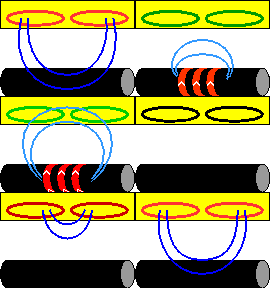
A pulse of current is sent (repeatedly) through a coil in the search head. This current tends to start up fairly gently (and is allowed to do so); see figure 1a. However, at the end of the pulse, it is arranged that the current turns off very rapidly (within a few microseconds); this (briefly) induces a very large "voltage spike" or "back-e.m.f" across the coil (rather like the induction coil used to generate the spark for a car engine ignition, though in this case the voltage is only(!) about 100 volts); see figure 1b. After the mayhem of this transient is over, there is no current flow through the coil and no voltage across it. After about a millisecond (or less or more, depending on the particular model) the whole cycle is repeated. The primary (or transmitted) magnetic field will vary with time exactly in step with the figure 1a current waveform, and propagates (rapidly -- at the speed of light) down to and through the target. When the pulse is switched off, and if the target is a conductor, eddy currents are induced to flow in the target. These eddy currents always flow in such a direction as to try to re-create the magnetic field that has just disappeared, and, initially at least, they actually succeed in this; but once the primary field has all gone, there is no source of energy to maintain these currents, so they decay gently away -- nevertheless persisting for about a hundred microseconds; see figure 1c.


The eddy currents generate a secondary magnetic field which propagates in all directions, including back towards the search head, where it induces a (small) voltage in the coil; this voltage also decays away at the same rate (see figure 1d), and has the same sign (polarity) as the back-emf spike. The received voltage from a target at the limit of the detection range may only be a few micro volts: one ten-millionth of the back-emf spike! It would be quite out of the question for the electronics to notice such a tiny change actually during the back-emf spike, and that is not the way it's done. The signal is "sampled" by an electronic switch which ignores the signal during the transmit pulse and immediately after (during the back-emf), and only "looks at" the signal after a short delay which ensures that the switch-off transient is over (see figure 1e). In this way, the transmitted and received signals are separated from each other. If the target had been purely magnetic, but non-conductive, it would have become magnetized by the transmit pulse, and then de-magnetize just as promptly at switch-off; by the time of the delayed sample pulse, nothing would be happening down at the target, and therefore nothing would be happening up at the search coil. If the target is both conductive and magnetic (eg a ferrous metal), the eddy currents would be produced exactly as in the purely conductive case; the effect of the target's magnetic permeability is to enhance the magnitude of the effect (and also to modify the "time-constant" of the decay of the eddy currents). If there is no target at all . . . . . . . . nothing happens! Actually, there will always be a certain inescapable amount of electrical "noise" in the receiver coil and circuitry, and three techniques are used to filter this out to produce a final signal (in the absence of a target) which is very close to zero and absolutely rock-steady. The decay time-constant (persistence) of the eddy-currents, and hence received signal, depends (predominantly) on the target's electrical conductivity and size. Targets such as low-conductivity alloys or thin foils have a very short decay time; and the choice of a short or long delay between switch-off and sample can be arranged to either detect or ignore such targets. The ionic conductivity of sea- or brackish water is so low, and its decay time so short, that such signals have always decayed away before the sample is taken; so the P.I. technique is not affected by moisture.

Monday, June 20, 2011

My old girl, the Fisher 1280-X Aquanaut VLF submersable, metal scope (m-scope) metal detector


I have used this detector exclusively for over 10 years and it was great. I never washed the salt water off it and never had a problem (besides wearing out the battery holder) . I could not wait each time to go out and find coins and jewelry with it. 
I know there were times, but I really cannot remember coming home empty handed. And while it has helped me find many things, I have probably lost a girlfriend or two because I spent too much time with it!


This waterproof machine is awesome at the beach in sand or in dirt. It works good underwater but in the salty ocean it can give false signals like most VLF detectors unless properly adjusted, usually at the cost of some depth. It can be annoying in the ocean and is the reason I finally got a Garrett Infinium Pulse Induction Unit (PI) for salt water but it is not as annoying as most other VLFs and has better depth than some others because of it's relatively low operating frequency (2.4 Khz).

When using the 1280-X,  and you get a target signal, it sounds like a mosquito buzzing near your ear and with practice you can most times tell by pitch what the buried target is. You will at least become a very good guesser.  If no targets are near, the sound is silent (silent search).


It with see most gold rings and pendents but will not see small gold or chains.

I have kept a few things I found with it in the past 10 or so years, but at times I sold items to help pay bills. There was also TON of clad coins and trash not shown. Most silver is black like coal when I find it, nothing a little Tarn-x cleaner can't remove. My next purchase will be a small jewelry polisher to shine up the jewelry.


The coin looking medallions on the right are from a leather hat band I found buried in the sand on an old beach in Tampa bay. The beaches in there have a lot of trash. I would tune them out with the discrimination knob (also tuning out any gold),  then blast through the garbage getting signals from coins and silver... only having to dig once in a while. A lot of these items were also found in parks, old vacant lots and homesteads.

I don't use this machine like I once used to, since getting a Garrett Infinium and AT Pro. The AT can drive you crazy sometimes near salty sand and also from interference because of its high 15 Khz operating frequency that enables it to see very small gold. It is at these times (when not searching for small gold) when I need a lower frequency machine like the 1280-X with the discrimination that the Infinium (Pulse Induction) does not have. There are old Minelabs and other VLFs that have a frequency switch for this very reason. It seems the lower frequency you go, the better the VLFs will do in salty water, but the lesser they find small gold.

Thursday, June 16, 2011

Garret Infinium brings home gold from Clearwater Beach 6-15-11


View Larger Map


1 1/2 hour at Clearwater Beach. This beach is pretty clean except around garbage cans or where they once were. I was mostly in the water with the Infinium, but I always make a point to hit the Volleyball courts as the trash is pretty much cleaned out from them leaving behind the small stuff older VLFs miss.

2 gram Diamond Earring and 1.1 gram - 10 Karat Gold tooth cap. earring from the water, tooth cap from the Volleyball courts.
Someone lost the "Bling" from their "Front Grill".

Tuesday, June 14, 2011

Garrett Infinium at Cleatwater Beach Southern Point


About 4 hours out with Garrett Infinium fitted with 3x7 in. Double D coil
 Glad I was not using a bigger deeper coil!
I also found about 20 bobby pins and pop caps not shown.

4.9 gram solid Silver ring stamped 925 inside. Unit was black when I found it, I discovered early on that silver found in salt water is black unless it was lost recently. Tarnex cleaned it up a bit.

Monday, June 13, 2011

Top 10 Most Valuable U.S. Coins Found in Pocket Change

There are a number of fairly valuable U.S. error coins and die varieties in circulation today. These coins are overlooked by people because they have small distinguishing characteristics, such as a modest doubling of the coin image, or minute differences in the size or spacing of the letters in the legends. Learn which of your pocket change coins is worth a large premium over face value, and why.
Note: Click on the images to greatly enlarge them and see details.
Tip: Be sure to do your hunting with at least a 6x power magnifier so you don't miss anything!

1. 1969-S Lincoln Cent With a Doubled Die Obverse

Valuable Coin 1 - 1969-S Doubled Die CentPhoto courtesy of Heritage Auction Galleries
This coin is exceedingly rare. The early specimens were confiscated by the Secret Service until the U.S. Mint admitted they were genuine. Counterfeits abound, but usually have the wrong mint mark.
How to Detect: Look for clear doubling of the entire obverse ("heads" side) except for the mint mark. If the mint mark is doubled, it is probably a case of strike doubling, rather than a doubled die, which isn't worth much. (Mint marks were punched in the dies separately in 1969, after the doubled die itself had already been made.)

2. 1970-S Small Date Lincoln Cent With a Doubled Die Obverse

As with virtually all true doubled die varieties, only one side of the coin shows doubling. If both sides exhibit doubling, the coin probably exhibits strike doubling instead, and is worth little.
How to Detect: The rarer Small Date variety is most easily distinguished from the common type by the weakness of LIBERTY. The Doubled Die Obverse is best demonstrated by doubling in LIB and IN GOD WE TRUST.
Approximate Value: Around $3,000 in EF-40 or so.

3. 1972 Lincoln Cent With a Doubled Die Obverse

The 1972 (no mint mark) Lincoln Cent doubled die variety shows strong doubling on all elements. The "Cherrypicker's Guide to Rare Die Varieties", which was an important source for this article, suggests using a "die marker" to help verify your finds. A die marker is a gouge or crack that identifies a particular die.
How to Detect: Clear doubling of all obverse elements; look for a tiny gouge near the edge above the D in UNITED as a die marker.
Approximate Value: About $500 in EF-40 or so.

4. 2004-D Wisconsin State Quarter With an Extra Leaf

Variety experts disagree about the cause and long-term value of this type, but I've included in the list because it is very findable in pocket change and worth hundreds of dollars right now.
How to Detect: There is some defect on the die that makes it appear as if there's an extra leaf on the lower left-hand side of the ear of corn on the reverse. The leaf is very clear. Known in two varieties, the High Leaf and the Low Leaf type.
Approximate Value: $200-$300 in MS-60 or so.

5. 1999 Wide "AM" Reverse Lincoln Cent

This variety is known for 3 dates, 1998, 1999, and 2000, with 1999 being by far the rarest. The mint erroneously used a proof die to strike normal circulation coins.
How to Detect: The AM in AMERICA on the reverse is clearly separated in the Wide variety. In the normal variety for these dates, the letters AM are very close or touching.
Approximate Value: $5 to $25 in circulated condition, $75 to $600 in MS-63 or better depending on color. 1999 brings the highest prices, with 2000 being second.

6. 1982 No Mint Mark Roosevelt Dime

At the point in time that these coins were made, the dies sent to the individual branch mints would be punched with the proper mint mark letter for that branch. This variety is believed to be caused because one or more non-punched dies were used to make coins. (The letter P was being used for Philadelphia on dimes at this time.)
How to Detect: The 1982 dime is missing a mint mark.
Approximate Value: About $30 to $50 in AU-50, more for higher grades.

7. Presidential Dollar Edge Lettering Errors

Ever since the first Presidential Dollar (the Washington Dollar issued in 2007) there have been errors associated with the lettering on the edge of these coins. In some cases it is missing entirely. In others, the edge lettering has been placed there multiple times.
How to Detect: Look at the edge. The inscription should appear fully incused all around the circumference of the coin. Missing or doubled inscriptions are rare and valuable.
Approximate Value: $50 to $3,000, depending on the President.

8. 1995 Doubled Die Obverse Lincoln Cent

This doubled die variety generated a lot of mainstream interest when it was featured as a cover story in USA Today. Specimens are still being found in circulation all the time!
How to Detect: Clear doubling in LIBERTY and IN GOD WE TRUST.
Approximate Value: About $20 to $50 in Uncirculated condition.

9. Certain Uncirculated State Quarters

As the economy has worsened, people who have been hoarding rolls of State Quarters have been spending them into circulation. If you can put together whole rolls Uncirculated quarters of certain in-demand states, you can get as much as $50 per roll for them.
How to Detect: Demand changes from time-to-time based on major coin dealer promotions. Currently, look for Georgia, Connecticut, Tennessee, and Illinois. Quarters must be Uncirculated!
Approximate Value: $20 to $52 per roll for strictly Uncirculated rolls of certain states. For current updates, see the State Quarter Rolls Value Guide.

10. Silver Half Dollars

Most people think that the silver in U.S. coins ended in 1964, but this isn't true. The Half Dollar coin had silver in it until 1970. Many people spend the Half Dollars from 1965 to 1970, or sells them in rolls of halves they take to the bank, not realizing they are 40% silver.
How to Detect: If the Half Dollar is dated 1964 or earlier, it is 90% silver. Halves dated from 1965 to 1970 are 40% silver. You might also find silver Proof Half Dollars, which are 90% silver and dated to current. Silver Proof Halves have very shiny, mirror-like surfaces and there is no copper color when you view the edge.
Approximate Value: Value is based on silver spot price.
Advertisement
Coins Ads

Thursday, June 9, 2011


View Larger Map


View Larger Map

3.5 gram "Create" power pendant made of fine silver and copper.
Volley ball courts are usually fertile hunting grounds. Earrings, pendants, coins and rings are always getting lost there. At this one I found a small amount of garbage, around $2 in change and this cool small silver pendant.


Tuesday, June 7, 2011

Silver with the Garrett Infinium Advanced Pulse Induction metal detector


View Larger Map

View Larger Map


The rest of the stuff from about 45 minutes of hunting. The Sterling pendant was found almost a foot down in black mud.

If you can imagine the hardened sand and oxidation completely encasing the pendant, that is how I found it.


The small parts with the imprint of the pendant I peeled off are Silver Oxide and Sand that formed over time from the salt water (I am guessing here)

A small "sterling" stamp on the back confirms Silver! - On my portable scale, wt= 3.2 Grams
After cleaning with "Tarnex", Saint. Jude... patron saint of "Lost Causes". Ironically with all the trash in this area, I was thinking just before I found it, that searching here may be "a lost cause". so I was digging only lo-high signals.